News
Implementation of the Creative Industries Growth Strategy is moving from talk to action
- Creative industries
- Society

Miia Pöytälaakso
Communications Specialist
+358 400 613 530
miia.poytalaakso@designforum.fi
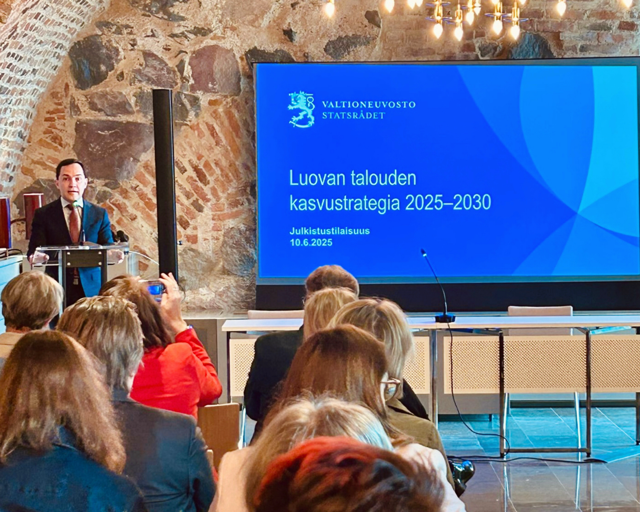
The latest meeting of Finland’s Advisory Board on the Creative Economy signaled a clear shift from strategy to implementation in the development of the country’s creative industries. Ongoing initiatives, new international collaboration models, and growing ministerial-level commitment all indicate that the role of the creative sectors in driving Finland’s economic growth, exports, and intangible value creation is now being strengthened more systematically than before.
During the meeting, the Ministry of Education and Culture and the Service Centre for Continuous Learning and Employment (JOTPA) presented updates on new higher education intake places for autumn 2026. Creative industries have been given increased emphasis within the framework, with new criteria highlighting the importance of intangible value creation, commercialization, and business competencies.
Strengthening the connection between education and working life also emerged as a key theme. Arto Pekkala from the Finnish National Agency for Education outlined ongoing efforts to make degree structures more flexible, allowing students to combine studies across disciplines more easily. At the same time, concerns were raised regarding the lack of entrepreneurial and commercialization skills within the creative sectors. Tapio Kujala, representing Finland’s arts universities, noted that entrepreneurial skills still attract relatively limited interest among students, despite the growing need for internationalization and the commercialization of creative work.
The meeting also featured extensive discussion on export promotion and Finland’s country branding efforts. Team Finland’s new sector group focusing on high value-added services, consumer business, and creative industries has now begun its work, aiming to create clearer internationalization pathways for Finnish companies. Design Forum Finland represents the design sector within the group and contributes to the development of Finland’s international design offering.
The group’s chair, Marja-Liisa Permikangas, stated that the working group has already convened twice this spring. A strategic action plan is currently being prepared ahead of the summer, focusing on export promotion through thematic concepts, phenomena, and target audiences. Discussions highlighted the growing importance of authentic storytelling and thematic relevance in the international marketing of Finnish consumer brands.
The meeting also highlighted the joint DesignFinland initiative by Design Forum Finland and Marketing Finland, with pilot activities launching in June. The initiative aims to strengthen the commercialization and internationalization of Finnish design expertise while building new collaboration models to support creative industry companies. Participants identified the project as one of the most promising practical initiatives currently advancing the implementation of Finland’s creative economy growth strategy.
The discussion further emphasized the need for stronger support networks around creative industry professionals. One proposed development area was closer collaboration with agents and management professionals, particularly to address existing gaps in internationalization and contract expertise. Strengthening legal, commercial, and negotiation capabilities was repeatedly identified as a critical development need across the sector.
Mika Kukkonen, Head of Country Branding at Finland’s Ministry for Foreign Affairs, presented Finland’s new country branding strategy, whose central message is encapsulated in the slogan Making Happiness Happen. The strategy aims to strengthen Finland’s international profile through themes such as sustainability, education, security, creativity, and quality of life. Happiness has increasingly become a defining element of Finland’s global image and was seen as offering new opportunities for the export potential of the creative industries.
A central communications tool supporting the strategy is the Finland Toolbox platform, which includes Finland’s new international brand video. The video brings together the strategy’s core themes and seeks to position Finland globally as a country defined by creativity, sustainability, innovation, and wellbeing. The Toolbox also provides organizations and companies with shared visual assets and communication materials to support international visibility and consistent country branding.
The role of cultural diplomacy also emerged as an important topic in strengthening Finland’s international influence. A new cultural diplomacy framework commissioned jointly by the Ministry of Education and Culture and the Ministry for Foreign Affairs is expected to be published in June.
Meanwhile, Business Finland emphasized the growing importance of intangible investments in building Finnish companies’ competitiveness. Participants noted that many businesses still lack sufficient understanding of how creative expertise can contribute to commercial growth and innovation. Business Finland will publish a new guide on intangible investments later this summer and organize a financing-focused event on June 9.
The Advisory Board on the Creative Economy will report on the progress of the growth strategy implementation to Finland’s ministerial working group on employment and economic policy later this month. Member organizations have been asked to submit updated overviews of ongoing initiatives and proposals for topics to be addressed during the autumn meetings. Based on the discussions, the next critical phase will focus on transforming strategic objectives into concrete actions that generate exports, growth, and international partnerships.
Photo: Entrance of the Finnish Government Offices. Photo by Sanna Lahovaara / DFF